

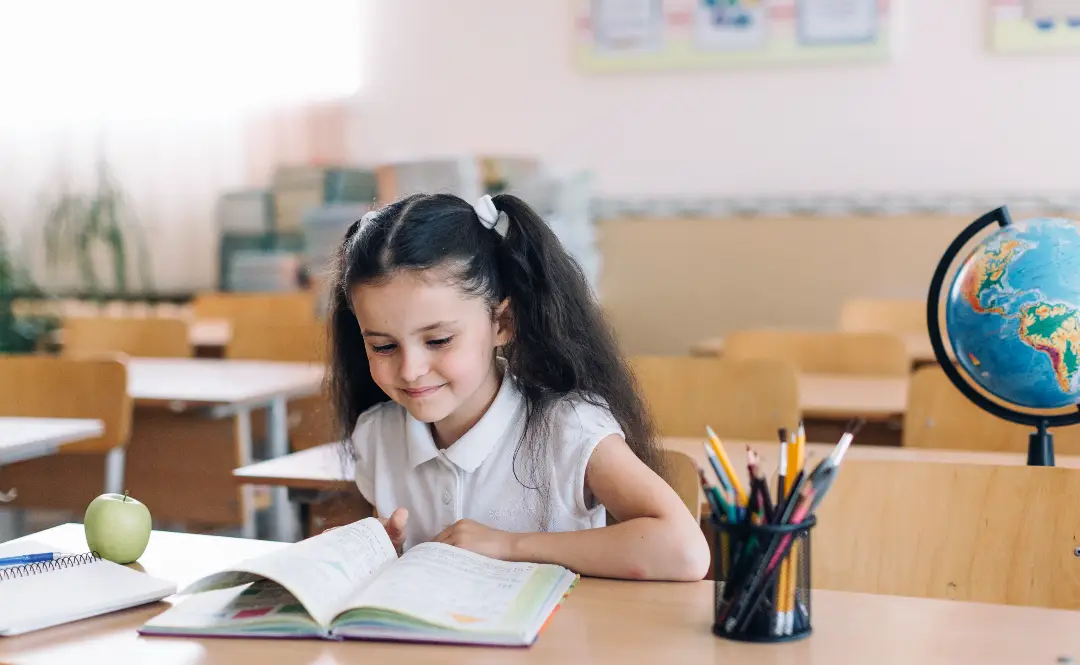
When parents think about school readiness, they often focus on academic abilities such as recognizing letters, counting numbers, or knowing colours and shapes. However, school is a place where a child learns much more than academics.
For many children, going to school is the first major transition away from home. Until then, the child is surrounded by familiar people and routines. Entering school means stepping into a completely different environment — one that includes unfamiliar adults, teachers, and peers. From the very first day, children may find themselves surrounded by people they do not yet know and may not immediately feel comfortable with.
Hence it takes much more than academic skills to adapt well to a school. It needs the child to have the ability to understand situations, other people and adjust to all these in a way that is socially appropriate.
Within the NHDP (New Horizons Developmental Program) framework, school readiness is therefore evaluated through a developmental lens, focusing on how a child adapts socially, communicates, and responds to new environments.
Why is Developmental readiness an important aspect for every Child
At school, it is required of the child to experience unfamiliar spaces, routines and expectations from other people. They are required to observe their peers, teachers and others and behave in an appropriate way and interact with them and take part in all the activities at school. It’s important that to be able to do so a child needs to exhibit the developmental skills that go beyond academic skills. These include the ability to observe others, understand instructions, express needs, and adjust behaviour based on social situations.
In many ways, academic readiness grows from developmental readiness.
Five Questions That Help Assess School Readiness
According to the NHDP framework, school readiness can be evaluated by considering the following key parameters.
1. Is the Child Comfortable Without Parents?
A child entering school must be able to remain comfortable in the presence of adults who are not their parents.
These adults are primarily :
- the teachers
- the school staff
- relatives or other adults
- unfamiliar people in the school environment that the child may need to interact with
A child who feels comfortable and in control and in an emotional regulated state in these situations is more prepared for school.
2. Can the Child Adapt to unfamiliar and new Situations?
At the school every child faces new situations, surroundings and expectations of others and from others.
A child who is ready for school adapts to these with minimal assistance or intervention from parents or teachers.
3. Does the Child Understand and Follow everyday instructions?
In a classroom or at the school, children need to follow instructions and respond in an appropriate way.
This includes the ability to:
- understand basic directions
- follow instructions during various activities and tasks
4. Can the Child Express what he or she needs and wants ?
Communication plays a major role in school readiness.
Children should be able to express their needs:
- Non-verbally (using gestures, pointing, facial expressions, or body language)
- Verbally (using words and spoken words that make sense)
5. Is the Child Comfortable with other children around ?
School is at the root of it all a social structure. Children learn from teachers, the school staff andby observing and interacting with other children with whom they interact in school or observe around them.
Comfort around others allows children to:
- observe the behaviour of others’
- participate in activities with a group
- build friendships and social confidence over a period of time
This aspect of readiness connects closely to a child’s social interaction development.
The Social Interaction Ladder
Within the NHDP framework, school readiness is closely linked to the child’s progress through what can be understood as a Social Interaction Ladder.
Before children become ready for structured academic learning, they typically move through important stages of social development.
Human Engagement and interaction
Human engagement and interaction is the earliest layer of development, preceding even social behaviour. It refers to the child’s beinh interested in humans and having an interest in interacting with them. These consistent, reciprocal exchanges form the foundation upon which all later social learning is built.
Social Behaviour
At this stage, the child begins to notice and observe other people. They become aware of others around them and respond to social cues such as eye contact, facial expressions, and shared attention.
This awareness exhibited by the child forms the basis of social learning.
Non-Verbal Communication (NVC)
Children start communicating through gestures, pointing, eye contact, and body language, before they communicate using words. They may tell us of their needs, interests, or respondthrough gestures without actually speaking.
Non-verbal communication is an importantstep in early social interaction.
Verbal Communication (VC)
In the later stages of development, children begin using words to communicate with others. They express needs, respond to instructions, and indulge in simple conversations.
When children move through these stages —
Social Behaviour → Non-Verbal Communication (NVC) → Verbal Communication (VC) — they develop the social understanding necessary to participate in group environments such as school.
Social Readiness Leads to Academic Readiness
When children develop these social interaction milestones, they become better equipped to observe others, understand expectations, and adjust their behaviour within a classroom setting.
In simple terms, social readiness forms the foundation for academic readiness.
A child who can interact comfortably with adults and peers, adapt to new environments, follow instructions, and communicate needs is far more prepared to engage in classroom learning.
School Readiness Through the NHDP Lens
At New Horizons Child Development Centre (NHCDC), school readiness is viewed through the NHDP framework, which emphasizes a child’s developmental milestones rather than focusing only on early academic learning.
This approach ensures that children are not just prepared to enter school, but are ready to adapt, participate, and thrive in a learning environment.
Ultimately, school readiness is not simply about knowing the alphabet.
It is about helping children develop the social understanding, communication skills, and adaptability needed to navigate a new world beyond home
What age should a child be ready for school?
Age is not the only factor that determines School readiness. While a majority of children begin school from 3 and 5 years of age, it is advised to assess readiness using developmental skills such as communication, social interaction, and the ability to adapt to new environments, as the major deciding factors
What are the most important milestones for school readiness?
Some key developmental indicators include:
1. Comfort around people other than parents and relatives
2. Ability to adjust to different environments and situations
3. Understanding and following simple instructions and adhering to simple routines
4. Communicating with others non-verbally or verbally
5. Interacting with other children and forming friendly bonds
What if my child is not ready for school?
If a child finds it difficult to adjust to new environments, interact with other children, follow instructions, or communicate its needs, it may show that certain developmental milestones need intervention and support.
Early guidance and intervention in this direction helps children build these foundational skills before school.
Why is social development an integral aspect of school readiness?
School is a social structure and environment. Children learn by observing other children and their teachers, taking part in activities, and responding to simple instructions in the class.
Strong social interaction skills help children adjust and adapt to school life and support academic learning at a later stage.
How do I get my child assessed at NHCDC?
📞Call us: 89769 64693 🌐 www.newhorizonscdc.in and book a consultation with our Developmental paediatricians.
They will be glad to answer any questions that you may have. We are every ready to support you in your journey in giving your child an empowered Life ahead.